Feature article by Nadia Muthoni

At the Kenya School of Government, as the curtains closed on the National Productivity and Performance Conference 2026, an institution that has spent two decades working quietly at the edges of Kenya's education system stepped into the national spotlight.

The Kenya Institute of Special Education better known by its acronym, KISE , walked away as the 1st most improved state corporation in the country for the 2024/2025 financial year, and claimed 3rd position overall in the state corporation performance category. For an institution whose daily work involves assessing children with disabilities, training specialist teachers, and building assistive devices rather than chasing headlines, the recognition landed like a long-overdue validation.

authour png

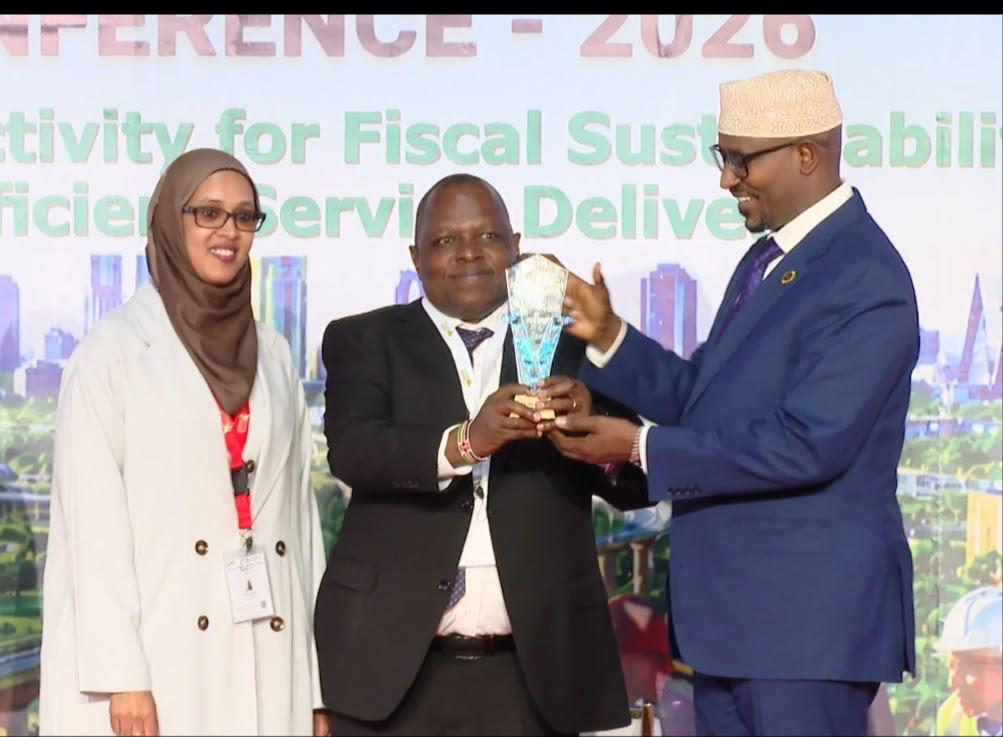
Dr. Norman Kiogora, the Director KISE and the KISE council secretary accompanied by Dr. Saida Aden Chairperson-Audit and Risk committee in the council, received the award on the institute's behalf, at a conference that brought together public institutions and stakeholders working to strengthen efficiency and accountability across Kenya's public service.

Dr.Norman Kiogora, Director KISE & Dr.Saida Aden Chairperson-Audit and Risk Committee receive the award.

It would be easy to file this under routine bureaucratic achievement ,another plaque for another government office wall. But for KISE, the award carries a different weight. It is a measurable signal that an institution built to serve some of Kenya's most overlooked citizens learners with disabilities and special educational needs ,can also be a model of organizational excellence.

The institute was established under the Kenya Institute of Special Education Act No. 12 of 2004 and became operational in 2005. Since then, it has grown into the nation's premier institution for special needs and inclusive education, training teachers and professionals, conducting specialized research, carrying out psychoeducational assessments, and developing learning materials for classrooms across the country

Its most visible recent innovation is the KISE Assistive Device Factory, a production unit turning research into physical tools that put mobility, communication, and learning within reach for children who might otherwise be left behind by a mainstream curriculum built without them in mind.

The award did not arrive in isolation. It capped a year in which KISE pushed further into uncharted territory for the institution.

Earlier in 2026, KISE convened its first-ever symposium on Autism Spectrum Disorder, pulling together researchers, educators, legislators, policymakers, and families into one room to compare notes, share evidence, and coordinate support for affected learners ,a first for an institute that has historically worked through smaller, more dispersed channels.

The institute also launched a national diagnostic tool designed to identify gifted learners, built through a multiagency process aimed at catching exceptional ability early and connecting it to appropriate support. It is a small piece of a much larger ambition: making sure no learner, whether facing a disability or an unrecognized talent, slips through the cracks of a system not originally designed with them in mind.

Much of the credit for KISE's rising profile is being traced back to its leadership. Dr. Kiogora is described by colleagues and stakeholders as an administrator who has pushed the institute to engage more deliberately with partners across the education sector, translating research into practice and policy conversations into programs learners can actually feel the benefit of.

That approach , responsive to emerging challenges, anchored in research, but built through partnership rather than isolation ,is one stakeholders point to when explaining why an institute historically operating in the background is now being held up as a national example.

Behind the ranking sits a simpler story: an institution that has spent years trying to answer a hard question ,how does a country ensure equitable access to quality education "regardless of ability or disability"? and is now being told, in the language public administration understands best, that its answer is working.

KISE's strategic plan envisions a Kenya where learners with disabilities and special needs have equal access to opportunity and an improved quality of life. The institute has framed its recent momentum the award, the symposium, the diagnostic tool, the assistive device factory not as separate wins, but as different expressions of that same underlying commitment.

KISE has been quick to frame the recognition as a collective one, crediting its management, council of directors, leadership team, staff, partners, and the Government of Kenya for the institutional turnaround. It is, in the institute's own framing, proof of something harder to quantify than a performance ranking: that investment in innovation, human-centered service, and inclusion produces impact that can actually be measured and felt.

For a sector that too often operates at the margins of national conversation, the message from the Kenya School of Government in June was clear. Inclusive education is not a footnote to national development , it is one of its pillars. And an institution built to serve Kenya's learners with disabilities has just proven it can also lead.

The Kenya Institute of Special Education continues its work training specialist educators, conducting psychoeducational research, and developing assistive technologies for learners with disabilities across Kenya.

WhatsApp Image 2026-07-29 at 12.15.09 PM

Post a comment

Your email address will not be published.

Related Posts